Yes, you can mow and fertilize on the same day. The catch is order and timing: Always mow first, then fertilize, and wait at least a few hours before you spread.
If you have flexibility, mowing a few days before fertilizing is even better and reduces the risk of nitrogen burn. This guide will walk you through the do’s and don’ts of mowing and fertilizing at the same time, so you won’t harm your grass.
Lawn fertilization requires the right timing, the right fertilizer, and sometimes proper mixing. If you’d rather skip the hassle, LawnStarter’s lawn treatment service covers the fertilization side of the equation (and usually includes weed control, too).
| Key Takeaways |
|---|
| • Mowing before fertilizing on the same day is acceptable, but mowing a few days before fertilizing is preferable. • Never mow immediately after applying granular fertilizer. Wait at least 24 to 48 hours before mowing to let the granules dissolve. • If you use liquid fertilizer in a soil application, you can mow as soon as it has fully dried. |
Should You Mow or Fertilize First?
Always mow first. If you fertilize before mowing, the mower wheels and blades will disturb the granules. And if you’re bagging clippings, you’ll literally mow away the fertilizer you just paid for.
When to Mow and Fertilize: Best to Worst Order
You know you need to mow and fertilize your lawn during its growing season, but getting the timing right makes the difference between a healthy lawn and a wasted bag of fertilizer.
| Timing | Rating | Key Benefit |
| Mow, then fertilize the same day | OK | Saves time |
| Mow a few days before | BEST | No nitrogen burn risk |
| Mow a few days after | OK | Works if planned ahead |
| Mow right after fertilizing | WORST | Wastes fertilizer |
Let’s look at each scenario in detail.
OK: Mowing and Fertilizing on the Same Day
Although mowing and fertilizing on the same day isn’t ideal, it can be done. You just have to be careful about the order: don’t cut your grass after applying fertilizer; instead, always mow before fertilizing if you want to do both on the same day.
Here’s why:
Mowing before fertilization helps the fertilizer spread more evenly.
Mowing removes debris like fallen leaves, helping fertilizer reach the soil more easily.
Mowing directly before fertilization means you won’t have to mow again for a week.
Doing both tasks back-to-back can take up your whole day, especially since you’ll want to wait a few hours after mowing before applying fertilizer. Why? Freshly cut grass tips are more vulnerable to the salts in your fertilizer and exposed to fertilizer burn.
| Pros | Cons |
| ✓ Allows for a more even spread of fertilizer ✓ Removes debris and growth that can block fertilizer ✓Gets mowing out of the way for the current week ✓ Allows grass to absorb fertilizer undisturbed | ✗ Lawn clippings can block fertilizer if not spread out properly ✗ More time-consuming ✗ Have to wait for a while to fertilize or risk nitrogen burn on your grass tips |
Can you leave the grass clippings on the lawn? Yes, if you mowed weekly, and it’s just a thin layer of grass clippings. If you’re mowing tall grass, it’s better to bag it to avoid clumping. Uneven piles of clippings on the lawn can prevent fertilizer from reaching the soil. The result? A patchy lawn instead of a uniform green.
See Related:
BEST: Mowing a Few Days Before Fertilization
Instead of mowing and fertilizing on the same day, mow your lawn a few days before or the day before fertilizing.
The benefits are the same as mowing right before fertilizing: more even application, easier soil penetration, and better absorption. Plus, you don’t need to worry about nitrogen burn when you wait a few days between tasks.
However, this requires 2 separate days of lawn care. A fertilizer schedule of 2 to 4 times per year means a little extra planning goes a long way.
You still have to be careful about spreading your grass clippings, as they won’t totally decompose in just a few days.
| Pros | Cons |
| ✓ Allows for a more even spread of fertilizer ✓ Grass clippings can be left on the lawn as additional fertilizer ✓ Gets mowing out of the way for the current week ✓ Allows grass to absorb fertilizer undisturbed ✓ Less risk of fertilizer burn on your turf’s blade tips | ✗ Lawn clippings can block fertilizer if not spread out properly ✗ Time to mow and fertilize needs to be allotted over 2 separate days ✗ You may need to clear your lawn of debris again before fertilization |
See Related:
OK: Mowing a Few Days After Fertilization
As an alternative to mowing before fertilization, you can mow after fertilizing. You’ll just have to wait a few days. Many of the perks of mowing before fertilization also apply here, but there are more drawbacks.
Wait 24 to 48 hours before mowing after fertilizing. You still need to schedule a 2-day lawn care project and clear debris from your lawn before fertilizing.
| Pros | Cons |
| ✓ Grass clippings can be left on the lawn as additional fertilizer ✓ Smaller risk for fertilizer to burn your turf’s blade tips | ✗ You’ll need 2 separate days for lawn care ✗ You may need to clear your lawn of debris before fertilization ✗ You need to wait at least 24 to 48 hours before mowing, and your grass can grow rather tall |
See Related: How to Mow Tall Grass In Your Lawn
WORST: Mowing Directly After Fertilization
Cutting grass directly after fertilizing is the worst order for these 2 lawn care procedures. The outcome is the same regardless of the situation: wasted time, effort, and money.
Most granular fertilizers need to be watered in to dissolve the granules and push nutrients into the soil. Mowing directly after that means mowing wet grass. This causes a sloppy, uneven cut and clogs your mower blades.
Using liquid fertilizer allows for a shorter waiting time. See the Granular vs. Liquid Fertilizer section below for the full breakdown.
| Pros | Cons |
| ✓ Less time-consuming | ✗ Redistribution and/or stripping of fertilizer from your lawn ✗ Can result in a patchy, uneven lawn from mowing wet grass, uneven fertilizer application, or both ✗ Wasted money, time, and effort |
Don’t have time for the best fertilization strategy? A lawn treatment professional can handle it for you. For most LawnStarter customers, lawn treatment costs $79-$120 per visit, or about $99 on average for a typical suburban lot (0.15 acres).
How to Mow and Fertilize on the Same Day
If you want to mow and fertilize on the same day, follow this 6-step guide to do it right while minimizing the risk of lawn damage.
Step 1: Check the Weather
Don’t schedule these tasks before heavy rain, as the fertilizer can be washed away.
Avoid mowing and fertilizing when it’s too hot or during a prolonged drought, as you could stress your turf and risk burning your lawn.
Step 2: Clean Your Lawn
Get rid of debris around your entire lawn, including fallen leaves, twigs, and rocks. Move all objects off the lawn so your fertilizer can reach the soil.
Step 3: Mow Your Lawn
Mow your lawn to the proper mowing height for your grass type. Make sure your grass is dry before mowing.
See Related: How to Mow Your Lawn: A No-Nonsense Guide
Step 4: Rake Any Grass Clumps
If you’re leaving clippings on the lawn instead of bagging them (a practice called grasscycling), make sure they’re spread evenly. Grass clumps act like a blanket, blocking fertilizer from reaching the soil beneath them.
Step 5: Fertilize Your Turf
Now it’s time to fertilize, but don’t rush it. Wait at least a few hours after mowing before applying, especially if you use a granular fertilizer.
This gives cut grass tips time to recover and reduces the risk of nitrogen burn.
Pro Tip: Always read your fertilizer’s label before applying. It tells you how much to use, whether to water before or after, and what safety precautions to take.
See Related: 8 Common Fertilizer Mistakes to Avoid and What to Do Instead
Step 6: Water Your Lawn
After applying granular fertilizer, water your lawn right away. About one-quarter inch is enough to wash the granules off the grass blades and into the soil. Skipping this step leaves granules sitting on cut grass in the sun, which accelerates nitrogen burn.
If you used liquid fertilizer, the recommended timing is 2 to 4 hours before watering for soil-applied products, but foliar feeds should remain unwatered for at least 24 hours.
See Related: Best Time to Water Your Grass
Granular vs. Liquid Fertilizer: Timing Differences
The type of fertilizer you use changes everything about same-day timing. Here’s the short version:
| Type | Minimum Wait Time Before Mowing | Key Features |
| Granular | 24 to 48 hours | Slow-release, cheaper, requires watering in |
| Liquid | A few hours (once dry) for soil-applied fertilizer 24 hours for foliar application | Quick-release, uniform coverage, more expensive |
Granular Fertilizer
Because the granules remain on the grass and soil surface until dissolved, always wait 24 to 48 hours before mowing after applying it. Mowing sooner can scatter or remove the granules before they break down.
Slow-release fertilizers provide a longer duration of nitrogen release than quick-release types and are usually safer to use on turf because of their reduced burn potential.
Note: Granular fertilizers must be watered in after application.
Liquid Fertilizer
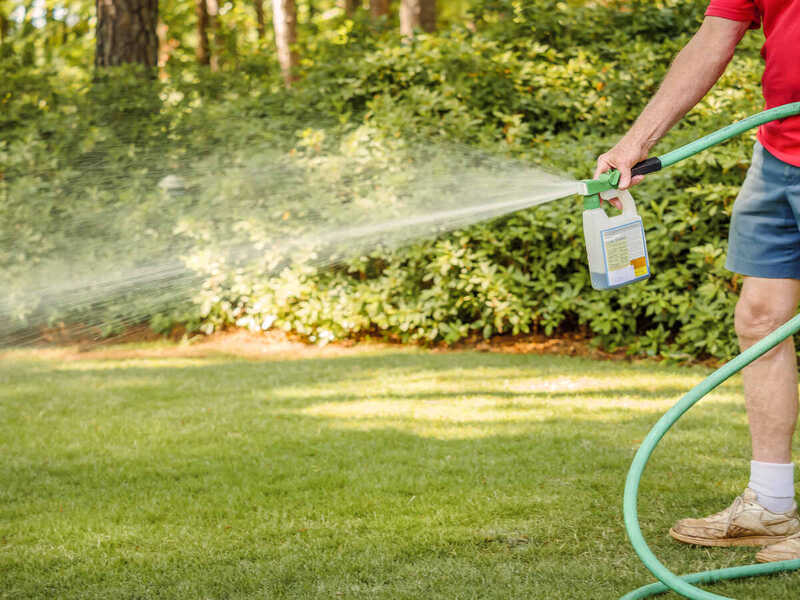
If it’s a soil application, you can mow a few hours after applying the fertilizer, as soon as it fully dries.
If it’s a foliar application, wait 24 hours before mowing. Fertilize during the day, give the grass blades a night to absorb the nutrients, then water in the morning and mow once the lawn is dry. According to the University of Arizona, grass blades absorb nutrients better at night.
Liquid fertilizer is typically mixed with water before being sprayed. It is easier to apply and generally allows for more uniform coverage. It can also be used together with herbicides and pesticides.
Note: Liquid fertilizer is usually quick-release. It feeds your lawn for only about 2 weeks before needing reapplication, and it’s easier to over-fertilize your lawn with it, increasing the risk of burning your grass.
See Related:
Let LawnStarter Handle Your Lawn Care
Doing both jobs the same day eats up your afternoon, and the timing is easy to get wrong. Mow too soon after fertilizing, and you waste the bag you just bought.
Get the order or the timing wrong, and you’re left with patchy growth, scorched tips, or fertilizer washed straight down the drain. That’s money and effort gone.
Why deal with all that? A LawnStarter lawn treatment pro handles the fertilizing for you, on a schedule that works around yours.
Read More: Fertilization and Weed Control Through LawnStarter: What’s Available?
FAQs
Yes. A soil test reveals which nutrients your lawn needs, helping you choose the right fertilizer with the right levels of nitrogen, phosphorus, and potassium. It also identifies pH issues and tells you if the soil is too acidic or alkaline and needs soil amendments.
It depends on your grass type. For cool-season grasses, October is ideal for a fall application to boost root growth before winter. For warm-season grasses, October is generally too late, as the grass is entering dormancy.
Yes, but it depends on the product and timing. For newly seeded lawns, follow the seed label and fertilizer label directions, and consider a starter fertilizer formulated for establishing grass. Avoid heavy applications that can burn tender seedlings, and water as directed to move nutrients into the soil.
Main Image: Person pushes lawn mower across green grass. Image Credit: romaset / Adobe Stock